


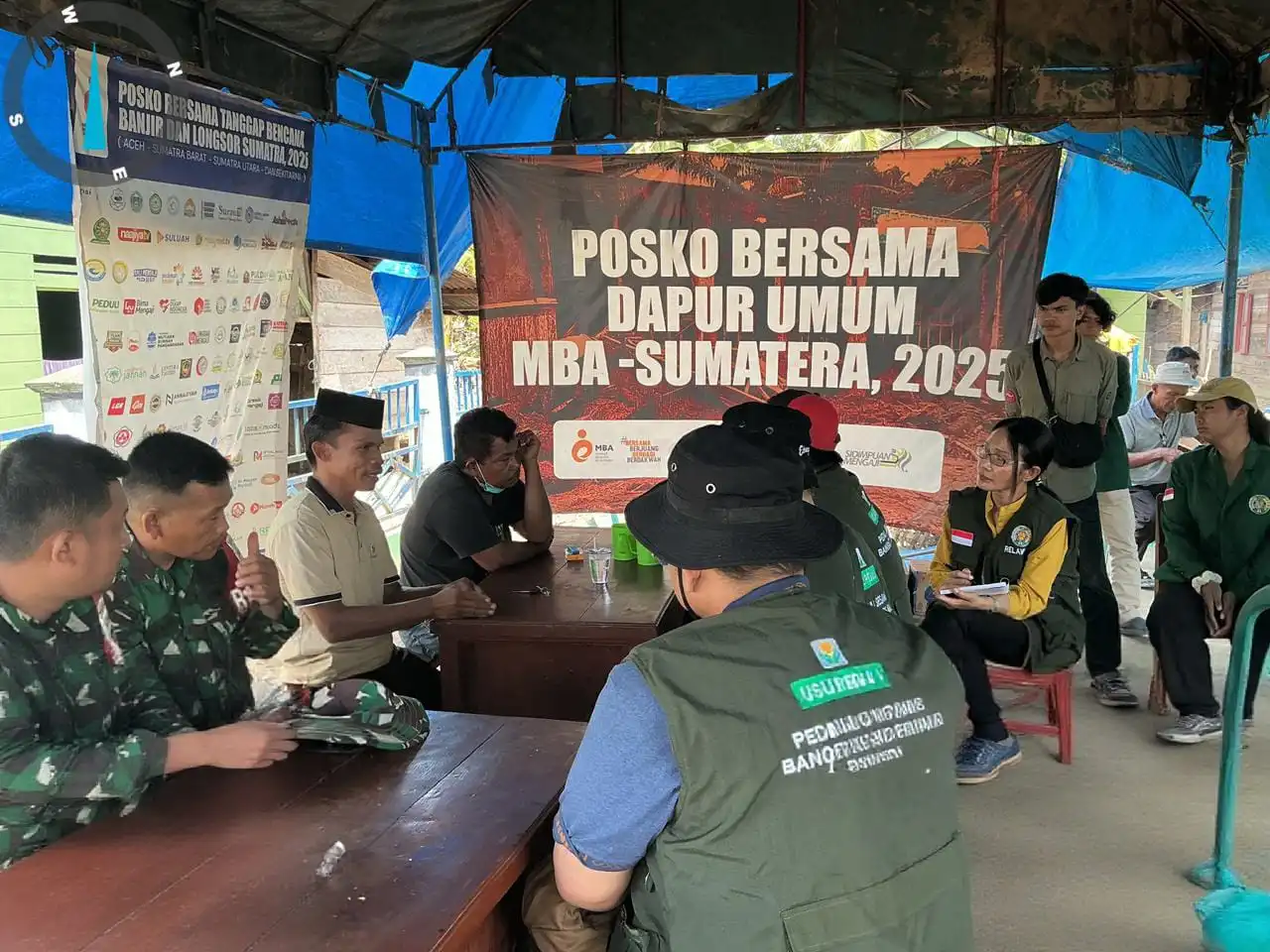
MEDAN – USU PEDULI PUBLIC RELATIONS: Universitas Sumatera Utara (USU), through USU Peduli, carried out surveys in several flood-affected areas in Sumatra, namely South Tapanuli Regency and Central Tapanuli Regency. The survey was conducted to document field conditions and assess the needs of affected communities. The survey activities were scheduled to take place from 20 to 25 January 2026.
On Tuesday (20 January) at 12:45 p.m. WIB, the USU Peduli team, consisting of 11 personnel—seven students and four lecturers—visited the main evacuation post in Aek Ngadol Sitinjak Village, Batang Toru Subdistrict, South Tapanuli. The team was welcomed by the village head and local residents for discussions regarding the condition of the evacuation shelters, including the number of evacuees at evacuation posts one and two.
Based on the discussion, it was found that the number of evacuees reached 1,497 people from 350 households. The discussion then continued with an assessment of the severity of the disaster experienced by two hamlets in the village. Community members and the village head explained that following the disaster, residents’ rice fields and plantations were buried under sand and mud due to flooding, reaching depths of approximately 1 to 1.5 meters.
These conditions have prevented farmers from resuming agricultural activities, while nearly 90 percent of the village’s livelihoods depend on the agricultural sector. The situation has been further exacerbated by the fact that the cleanup process must still be carried out manually.
Therefore, local residents strongly hope for assistance in the form of heavy equipment from the government to help remove the accumulated sand and mud from their fields so that farming activities can resume. In addition, the discussion also identified other priority needs, particularly the provision of clean water at evacuation sites to meet the daily needs of affected communities.
The survey in Aek Ngadol Sitinjak Village, Batang Toru Subdistrict, continued at 9:23 P.M at Nurul Islam Mosque with village officials and local residents. The discussion addressed plans for mutual cooperation activities (gotong royong) scheduled to take place on Saturday and Sunday for the installation of village water pipelines. The meeting also discussed plans to restock fish fry in the Lubuk Larangan River.
The plan to restock fish fry is based on the tradition of fishing in the Lubuk Larangan River, which is typically carried out during certain periods. This tradition is widely known and often attracts residents from neighboring villages to participate. However, due to the recent flooding disaster, all fish in the river died, forcing the tradition to be temporarily suspended.
Through the restocking of fish fry, the community hopes that the fish population in the Lubuk Larangan River can recover to pre-disaster levels, allowing the fishing tradition to be preserved. The discussion then continued by exploring various alternative solutions to other issues faced by Aek Ngadol Sitinjak Village in the aftermath of the flood.
The survey in Aek Ngadol Sitinjak Village continued on Wednesday (21 January) and was centered at the main evacuation post. On this occasion, the USU Peduli team, consisting of seven personnel—five students and two lecturers—once again held discussions with the community and village officials regarding follow-up actions to address the damage to the Lubuk Larangan River.
The activities reported in this news article represent the implementation of Sustainable Development Goals (SDGs) No. 11 and No. 17.
Reporter: Muhassanah Nasution